ABN (Australia Business Number)
1. Australian Business Number (ABN)
Australian enterprises use the Australian Business Number (ABN) as a unified identifier for all interactions with the Australian Taxation Office (ATO) and other government departments. The ABN is the key component for tax identification, GST registration, and issuing compliant tax invoices. Its introduction followed the Small Business Deregulation Task Force Report, replacing the fragmented system of ACN, ARBN, and agency-specific identifiers with a single number that state, territory, and local government regulatory bodies also accept to streamline registration requirements.
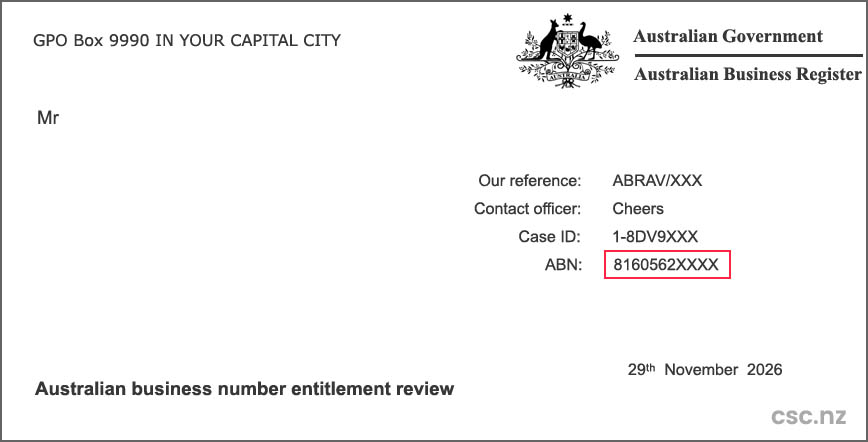
2. ABN Format and Structure
The ABN is an 11-digit number displayed as XX XXX XXX XXX:
| Segment | Digits | Meaning |
|---|---|---|
| Check digits | 2 | Derived from the nine-digit identifier via mod-89 |
| Unique identifier | 9 | Issued sequentially by the Australian Business Register |
For companies registered under the Corporations Act, the ABN is formed by prefixing two check digits to their Australian Company Number (ACN) or Australian Registered Business Number (ARBN) issued by ASIC.
Regex Pattern
| Pattern | Description |
|---|---|
^\d{11}$ |
Raw 11-digit string (no spaces) |
^\d{2} \d{3} \d{3} \d{3}$ |
Display format with spaces (XX XXX XXX XXX) |
^\d{2}\s?\d{3}\s?\d{3}\s?\d{3}$ |
Accepts both spaced and unspaced |
A regex match alone is insufficient — the mod-89 checksum must also pass.
Mod-89 Validation Algorithm
The ABN uses a modulus 89 checksum based on the following weighting factors:
- Subtract 1 from the first (left-most) digit of the ABN to give a new 11 digit number
- Multiply each of the digits in this new number by a "weighting factor" based on its position as shown in the table below
- Sum the resulting 11 products
- Divide the sum total by 89, noting the remainder
- If the remainder is zero the number is a valid ABN
For example, to check if 51 824 753 556 is a valid ABN:
- Subtract 1 from the first (left-most) digit (5) to give 41 824 753 556
- Multiply each of the digits in 41 824 753 556 by the "weighting factor" based on its position as shown in the table below
- Sum (Digit * weight) to give a total of 534
- Divide 534 by 89 giving 6 with zero remainder.
- As the remainder is zero, 51 824 753 556 is a valid ABN.
| Digit | Position | Weighting | Digit * weight |
|---|---|---|---|
| 4 | 1 | 10 | 40 |
| 1 | 2 | 1 | 1 |
| 8 | 3 | 3 | 24 |
| 2 | 4 | 5 | 10 |
| 4 | 5 | 7 | 28 |
| 7 | 6 | 9 | 63 |
| 5 | 7 | 11 | 55 |
| 3 | 8 | 13 | 39 |
| 5 | 9 | 15 | 75 |
| 5 | 10 | 17 | 85 |
| 6 | 11 | 19 | 114 |
| Total: | 534 |
Steps:
- Subtract 1 from the first (leftmost) digit.
- Multiply each of the 11 digits by its corresponding weight.
- Sum all 11 products.
- Divide the sum by 89 — if the remainder is 0, the ABN is valid.
Example — ABN 53 004 085 616:
- Digits: 5 3 0 0 4 0 8 5 6 1 6
- Step 1: 4 3 0 0 4 0 8 5 6 1 6 (subtract 1 from first digit)
- ×Wts: 10 1 3 5 7 9 11 13 15 17 19
- Products: 40+3+0+0+28+0+88+65+90+17+114 = 445
- 445 ÷ 89 = 5 remainder 0 → VALID